10 questions with Oli, co-founder of PreProduct
A pre-order starts on a product page, but the work reaches much further. Someone has to decide when the customer pays, what the warehouse should hold back, and how to keep the buyer informed while they wait.
For our first Stacked with Founders conversation, I spoke with Oli, co-founder of PreProduct. He and Eliza started the company in London in 2020, drawing on the experience of running a smart-home business. Today, PreProduct focuses on brands that sell in-stock products every day and need pre-orders to work alongside that business.
Below, Oli explains what he felt was missing, who the app is built for, and why he would test the whole order journey before launching a campaign. Answers have been lightly edited for clarity. Product observations and the pre-order figures in the answers are Oli's account, rather than independent findings by Startup Stacked.
What is PreProduct, and who did you build it for?
PreProduct is a pre-order app for Shopify that focuses on flexible charging, comprehensive fulfilment support and customer communication. It's built for established brands, often on Shopify Plus, that sell in-stock products every day and run pre-orders alongside them: a new collection drop, a hero product launch, a seasonal range, or simply keeping a sold-out product selling until the restock lands.
What first made you want to build it?
Before PreProduct I ran a smart-home company. Every new product meant a big upfront inventory bet with no real read on demand, and the options for selling ahead of stock either lived off our own site or didn't fit into how the store already ran. I wanted pre-orders that worked inside the store, checkout and fulfilment setup we already had.
What did you feel was missing from the pre-order tools already available?
Most tools treat a pre-order as a button swap. The hard part is everything after the click: charging the customer at the right time, and making sure a pre-order doesn't ship early or trip up a warehouse that pulls orders the second they're placed. Some tools solved that by replacing the checkout, which isn't an option for brands who rely on a lot of the native Shopify features: discounts, shipping, tax and ERP/3PL integrations.
What makes PreProduct different?
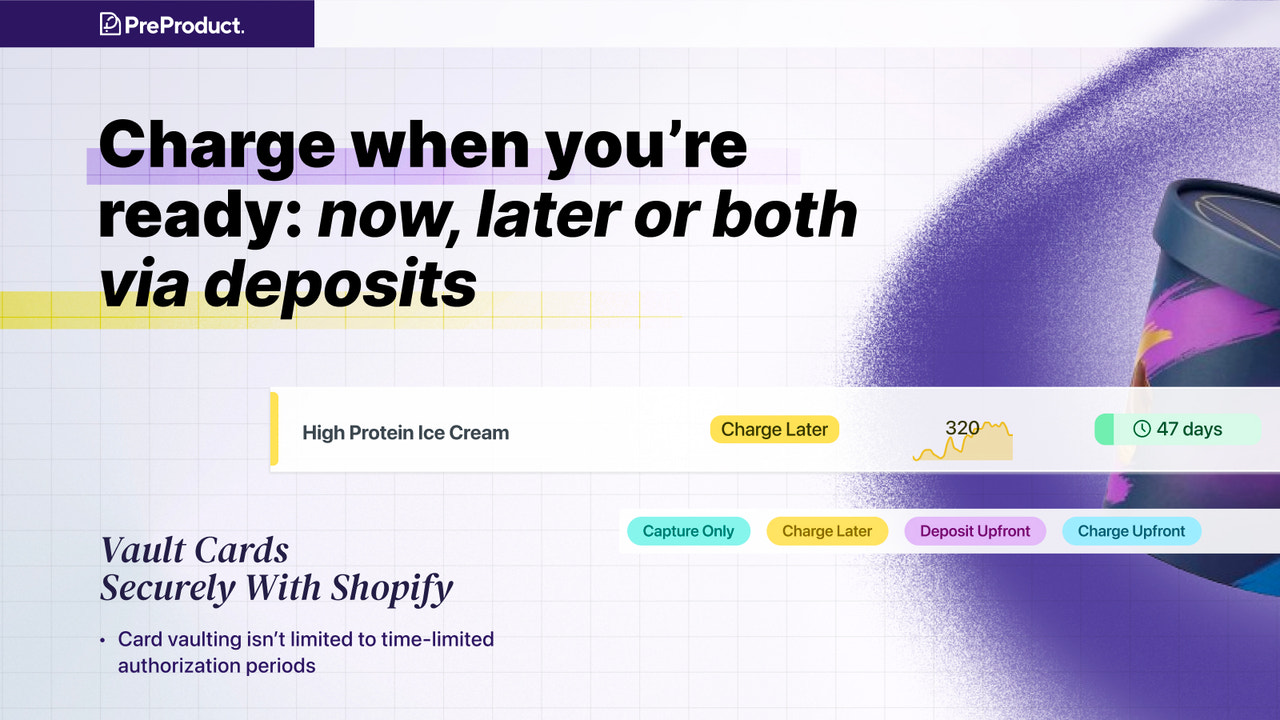
Three things. We keep the native Shopify checkout, so nothing a brand has already built breaks. We give full control over charging: upfront, later on a vaulted card, or a deposit, set per product, and triggered by hand for a one-off launch or by automation for ongoing pre-orders. And pre-order lines are held from fulfilment until they're ready, with clear signals on the order for 3PLs and ERPs. On top of that, the button, wording and emails look like the brand rather than a third-party widget.
Is there a feature or use case you think people tend to overlook?
Charging later. People assume pre-orders mean taking the money upfront, but when we looked at a million pre-orders processed through PreProduct, only about a quarter were charged on day one. Most brands charge closer to when the product is ready to ship, so the customer pays for something that's about to arrive rather than waiting months after paying.
Which businesses get the most value from PreProduct, and who might be better served by something else?
Brands running pre-orders alongside a live in-stock business get the most out of it, especially where orders flow automatically to a 3PL or ERP and a mistake would be visible. Hobby, collectables and large-catalogue stores, where pre-orders are a constant part of the business, are a great fit too. If you're doing less than around $1,000 a month in pre-orders, launching the business itself through pre-orders, selling bundles, or after a Kickstarter-style funding bar, there are simpler tools that will suit you better.
What has surprised you most, or taught you the biggest lesson, while building the company?
Probably just how wide a surface area pre-orders have across e-commerce businesses. They touch the Shopify product catalogue and stock levels, and then they're a big part of the storefront: the product page, add to cart and checkout.
Then there's making sure the Shopify Orders admin communicates the right information to the merchant, as well as customer portals and communication with pre-order customers.
And, last of all, making sure that any third-party logistics provider (3PL) or warehouse management system respects that the pre-orders aren't ready to be shipped yet.
How do you see pre-orders changing for ecommerce brands over the next few years?
The ability to vault customers' cards on Shopify has been around for a couple of years now, but we still have lots of merchants surprised that it’s an option. Often they assume payment has to be captured within the 7- or 30-day credit card authorization window.
So my guess is that this will become more popular. We've also been experimenting in the last year or so with things like multi-step payment plans and more flexible ways for customers to pay, with the goal of improving conversion for merchants. So I think there's still plenty of scope there.
What advice would you give a store owner planning their first pre-order campaign?
Decide how you'll charge and how fulfilment will treat pre-order lines before you launch, not after. Talk to your 3PL or warehouse early, set a clear shipping date with some buffer, and run a test order all the way through, from product page to charge to fulfilment. Most problems show up in that one test.
What are you building toward next?
More automation around stock. We've recently added location-aware pre-orders, so a product can be on pre-order in one country while it's still in stock in another, and we're building more listing automation driven by stock levels and incoming purchase orders. The goal is that brands set the rules once and pre-orders look after themselves.
My take
What stands out to me is Oli's focus on the decisions that come after the sale: when to charge, what to hold back, and what to tell the customer. His advice to run one order through the entire process is a useful starting point for any store planning pre-orders. PreProduct sounds most relevant when those decisions already involve a live store and a fulfilment team. His view that smaller campaigns may suit a simpler tool is just as useful when deciding whether it belongs in your stack.